Silver Screen Library
The Meanest of Times by Matthew Louis - Review

Follow Us:






Vigilante Crime & Pulp
B-
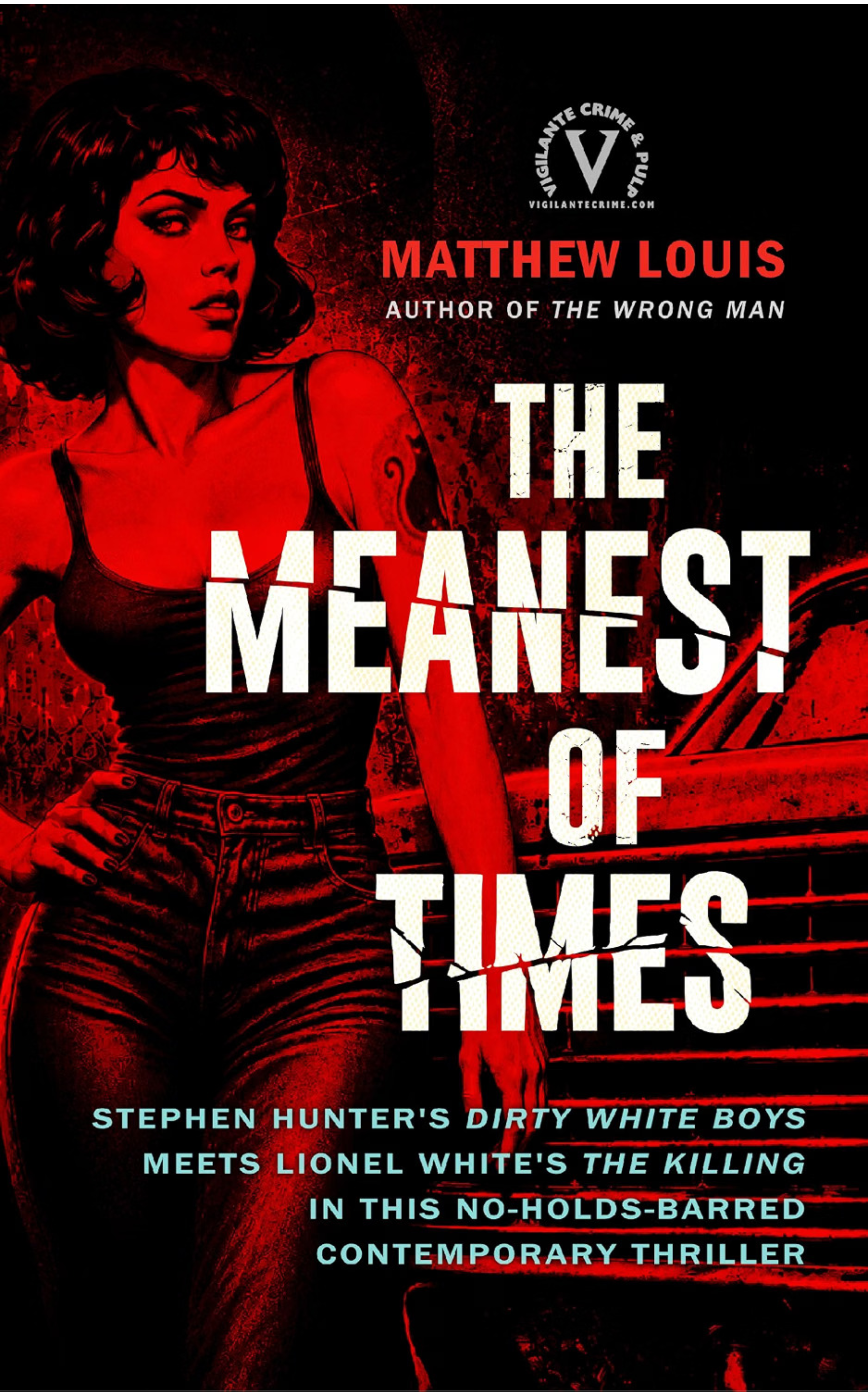
Baking aficionados are familiar with a recipe known as “kitchen sink cookies.” They are a type of cookie with multiple toppings and ingredients thrown into the batter or, in common terms, “everything but the kitchen sink.” Each chef seems to have their own variation. When it works, the cookies can be delicious; if it doesn’t… not so much. Author Matthew Louis tries his own version of a “kitchen sink” recipe in his crime novel, The Meanest of Times. He packs dozens of pulp conventions and characters, including a few novel ones, in a book that’s barely 200 pages long. Most of the time, the book works, but it’s also occasionally overstuffed and confusing.
The Meanest of Times takes place in Highland City, a medium-sized California town that’s currently the site of a drug turf war. The opposing forces are a Mexican cartel (that is more hinted at than fully described in the book) and a group of white nationalist racists whose members include several police officers. The book’s protagonist is Reed Hubbard, a down-on-his-luck MMA fighter, who is a classic example of a man in the wrong place at the wrong time. He witnesses one of the racist goons beat an autistic boy to death because the boy kept making bizarre noises. Hubbard tries to intervene and winds up being framed by a
crooked cop for the murder.
Much of the remainder of The Meanest of Times describes Hubbard’s efforts to stay alive, which include being captured by a crooked cop and forced to take part in some violent activities. I would need several pages to synopsize the plot adequately, so I won’t try. I will say that the book contains several plot twists, including several revelations that characters aren’t what they first appeared to be. In a clever touch, the author then replays some scenes to show how the story’s action wasn’t as it first seemed, once readers know more about the characters. The book also contains some time-honored clichés like dissolving a body in a vat of acid, a touch that was actually more gruesomely entertaining to read about than it first seemed. (The Meanest of Times has some rather graphic descriptions of violence and is definitely not for the squeamish.)
What really impressed me about The Meanest of Times was its depth of character development. The book has over a dozen significant characters, and the author switches points of view among them effortlessly. In lesser hands, these characters might be one-dimensional stereotypes, but the author brings them to three-dimensional life. My favorite character was the villainous mastermind, an entrepreneur who calls himself Paul. He didn’t choose his nom de guerre merely to disguise his identity. Paul chose that name as an homage to Paul Kersey, Charles Bronson’s character in Death Wish. I may be one of the few readers who is familiar enough with Death Wish to realize that the movie’s Paul Kersey epitomizes Paul’s view of himself as a righteous vigilante out to clean up his town. Another character I enjoyed was Jade, a hooker who was the dead autistic boy’s mother. Let’s just say that her character becomes more deviously complex, in classic femme fatale fashion, as the story goes along.
Ironically, the major shortcoming of The Meanest of Times is its shortness. The author crams about 20 characters, most of whom he describes in depth, and a complex, tricky plot into 200 pages. Several minor characters are completely unnecessary and merely take up space, such as Paul’s girlfriend’s best friend, who seems to exist for the sole purpose of having her friend describe what a weird guy Paul is. The author deserves considerable credit for resisting a common temptation in books like this to take shortcuts with his characters. Instead, by describing their personalities in depth, the author makes the plot twists and turns feel realistic rather than like thriller contrivances.
Unfortunately, the book’s complexity eventually overwhelms it. I read the last few chapters twice, and I’m still not sure what happened. The resolution is confusing, and I felt the author edited out some of the complexity. This book would have been much more successful if it had been another 50 pages long. Instead, many readers will just be confused by the events of those final chapters.
I enjoyed The Meanest of Times, but I feel that, like kitchen-sink cookies, it was a case of less might have been more. The book had many interesting characters, so much so that the protagonist, Reed Hubbard, often disappeared into the background. The book’s central concept of a group of racist cops and business people tangling with traditional drug cartels was highly original. However, like several other plot details, I think the author would have had a more entertaining book if he had explored that concept and some of his characters in greater depth. A longer book also might have made the ending easier to follow. Fans of hardboiled crime fiction will enjoy The Meanest of Times, but it won’t be the best of times.
NOTE: The publisher graciously provided me with a copy of this book through BookSirens. However, the decision to review the book and the contents of this review are entirely my own
In this clip, StudioBinder provides a brief introduction to film noir:
Read reviews of other books by Matthew Louis:
Matthew Louis is a writer, editor, publisher, and graphic artist. He founded Out of the Gutter Magazine and Gutter Books to deliver his brand of hard-boiled, gritty crime drama to readers. His novels include The Meanest of Times. Roots Down to Hell, and The Wrong Man, which is currently being developed as a motion picture. He received an honorable mention in the Year’s Best Mystery Stories for his contribution to Trouble in the Heartland.
Buy other books by Matthew Louis on Amazon:


Header Photo: "Riot Radio" by Arielle Calderon / Flickr / CC By / Cropped
Silver Screen Video Banner Photos: pedrojperez / Morguefile; wintersixfour / Morguefile
Join Button: "Film Element" by Stockphotosforfree
Twitter Icon: "Twitter Icon" by Freepik
Facebook Icon: "Facebook Icon" by Freepik
LinkedIn Icon: "LinkedIn Icon" by Fathema Khanom / Freepik
Goodreads Icon: "Letter G Icon" by arnikahossain / Freepik
Strand Magazine: "The Strand Magazine Bound Volume 1894" by Michael Maggs / Wikimedia Commons / Public Domain
Certain images on this site appear courtesy of Amazon.com and other sponsors of Silver Screen Videos for the purpose of advertising products on those sites. Silver Screen Videos earns commissions from purchases on those sites.
© 2026 Steven R. Silver. All rights reserved.
