Silver Screen Library
Murder to Movies by Paul Drexler - Review

Follow Us:






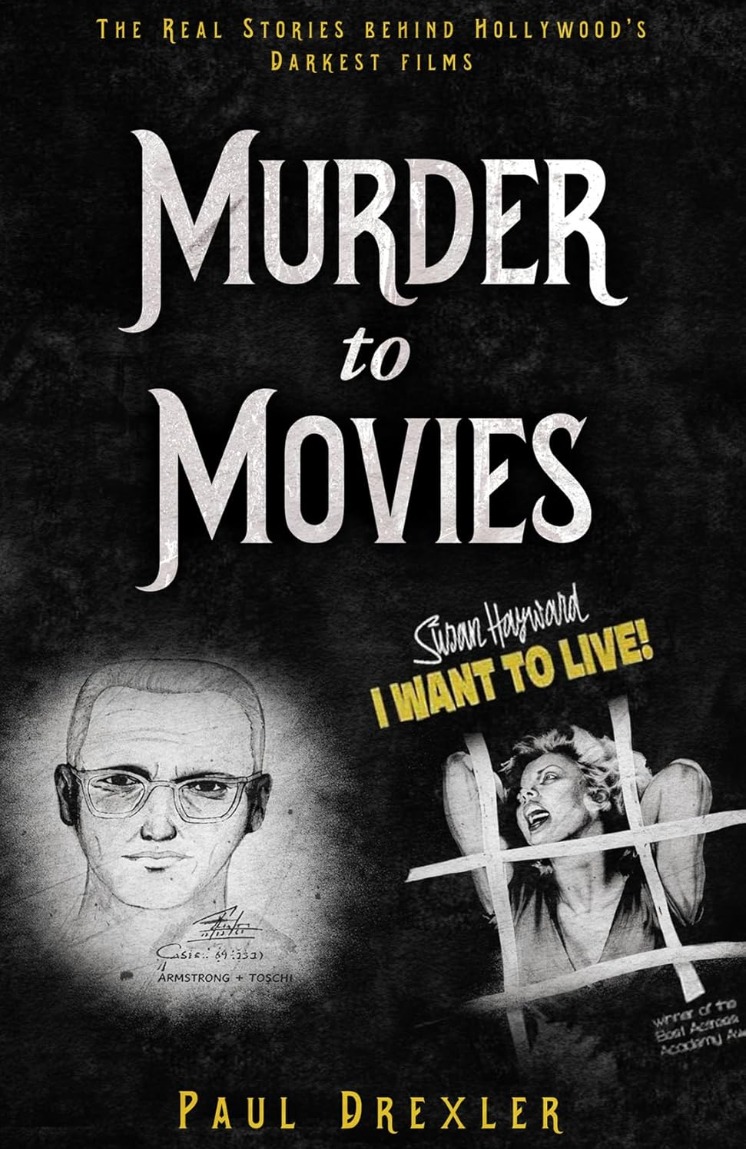
In 1959, Susan Hayward won the Best Actress Oscar for her portrayal of convicted murderer Barbara Graham in I Want to Live. The film was nominated for four other Oscars, including Best Picture and Best Director (Robert Wise). Sixty-five years later, another movie based on real-life criminal events, Killers of the Flower Moon, was nominated for 10 Oscars, including Best Picture, Best Director (Martin Scorsese), and two Acting Oscars (Robert De Niro and Lily Gladstone). Sensational crimes can attract the attention of A-list talent, as these two films show. However, audiences often want to know what really happened, rather than merely the Hollywood version. Author Paul Drexler looks at 17 real-life crimes (including the aforementioned pair) that received cinematic treatment in his study, Murder to Movies. He has a great eye for recognizing excellent source material, but inconsistent organization and confused storytelling dilute much of the book’s impact.
Murder to Movies examines 17 sensational crimes or series of crimes that have been adapted into films. Despite the book’s title, the cases did not all involve murder or killing. The cases took place worldwide, including Belgium, France, Greece, Jamaica, Japan, Russia, and the United Kingdom. Some of the film
adaptations, like David Fincher’s Zodiac, will be familiar even to casual film buffs. Others are considered classics, like Charlie Chaplin’s Monsieur Verdoux. However, over half of the films are obscure for all but the most dedicated film buffs. The author also stretches the definition of “movies” considerably, as two of the adaptations were British limited-TV series. A look at the catalog of any American streaming service would probably yield dozens of similar examples of interesting source material.
The book comprises 15 chapters, each covering one or two cases (two chapters cover what the author considers similar crimes). The organization of the chapters varies considerably. In some chapters, the author first describes the actual crime, then discusses the film (which I found to be the most effective organizational method). In other chapters, the author begins with a sometimes overly detailed synopsis of the film, followed by a discussion of the actual case. Finally, in some chapters, the author combines his discussion of facts and film so readers can’t tell how much of what appears on the page actually occurred and how much was the product of a screenwriter’s imagination. The author may have had little source information about some crimes beyond the film’s content, which would explain this narrative shortcut. However, he could have included hundreds of other sensational crimes with readily available background information instead.
Some chapters of Murder to Movies are well-researched, well-written, and informative, especially for those with little familiarity with the cases. The book begins with a lively discussion of two “you’ll-never-take-me-alive” shootouts in New York City from the 1930s and 40s. I especially enjoyed a more obscure case about a British man (played in the limited series by Eddie Marsan) who faked his death in a boating accident and remained in hiding for years while his wife tried unsuccessfully to collect on his life insurance policy. (Her memoir is one of the author’s sources.) The information about Barbara Graham is also quite good and easy to follow. Somewhat surprisingly, the chapter about Rasputin’s death contained details I had never seen before, even though I’ve read about the man for decades. (According to Murder to Movies, a British intelligence agent fired the last shot that killed Rasputin.)
While the discussion of Rasputin’s death contains some of the most fascinating information in the book, that chapter is also the most frustrating. Instead of starting with the facts of the case, the author engages in a lengthy plot review of Rasputin and the Empress, a 1932 movie featuring the three famous Barrymore siblings. Readers may get confused by being inundated with several pages of fictional supporting characters and plot details from a nearly century-old movie before the author discusses what actually happened. Also, by focusing on Rasputin and the Empress, the author ignores the dozens of other cinematic treatments of Rasputin’s life and death. (Wikipedia lists 20 other films that deal, at least in part, with Rasputin’s death.)
The author also includes a detailed plot synopsis of the obscure 1968 cop thriller Madigan in the chapter on “You’ll never take me alive” gunmen. I may be one of the few readers of this book who is familiar with Madigan, a movie I’ve seen several times. The movie has a minor subplot involving a gunman who holes up in an apartment building, but it’s primarily a film about the personal and professional rivalry between a detective (Richard Widmark) and the police commissioner (Henry Fonda). (The film is based on a novel entitled The Commissioner.) I like Madigan, but a lengthy plot synopsis of the movie had no business being in this book, especially at the expense of more relevant (and interesting) true-crime factual material.
Many chapters in Murder to Movies are only a few pages long, and the author sometimes tries to cram too much factual material into a few paragraphs. The result can be a confusing welter of names and places right after one another. I’ve seen Killers of the Flower Moon, but that plot synopsis left me quite confused. The author could have expanded his discussion of these cases to make the material easier to follow.
Sometimes, the author’s unusual organization in certain chapters works. He combines the discussion of the well-known San Francisco Zodiac killings and a Korean serial killer case that was sometimes referred to as the “Korean Zodiac Killer” case. The San Francisco killings of the 1960s and early 70s remain unsolved. The Korean killings took place in the 1980s, and police eventually obtained a forced confession from the prime suspect. However, in 2018, DNA evidence identified the actual killer, who was serving a life sentence in another case. Despite the complexities of the two cases, the author’s discussion and analysis in this chapter are excellent.
Paul Drexler, who wrote Murder to Movies, has had over 60 true-crime articles published in major newspapers and publications. I expected better and more consistent organization of the material from this author. At its best, Murder to Movies contains several fascinating chapters about crimes that, in some cases, are almost too bizarre to be believed. Unfortunately, the book also contains several dull chapters that probably won’t educate readers who weren’t already familiar with the underlying cases and films. I’m giving the book a three-star rating and a mild recommendation based on the case discussions that work. Overall, however, the book feels more like a misdemeanor than a capital read.
NOTE: The publisher graciously provided me with a copy of this book through BookSirens. However, the decision to review the book and the contents of this review are entirely my own.
In this clip, author Paul Drexler discusses Murder to Movies with Ezekiel Iferia on the FailCraft podcast:
Read other reviews of Murder to Movies:
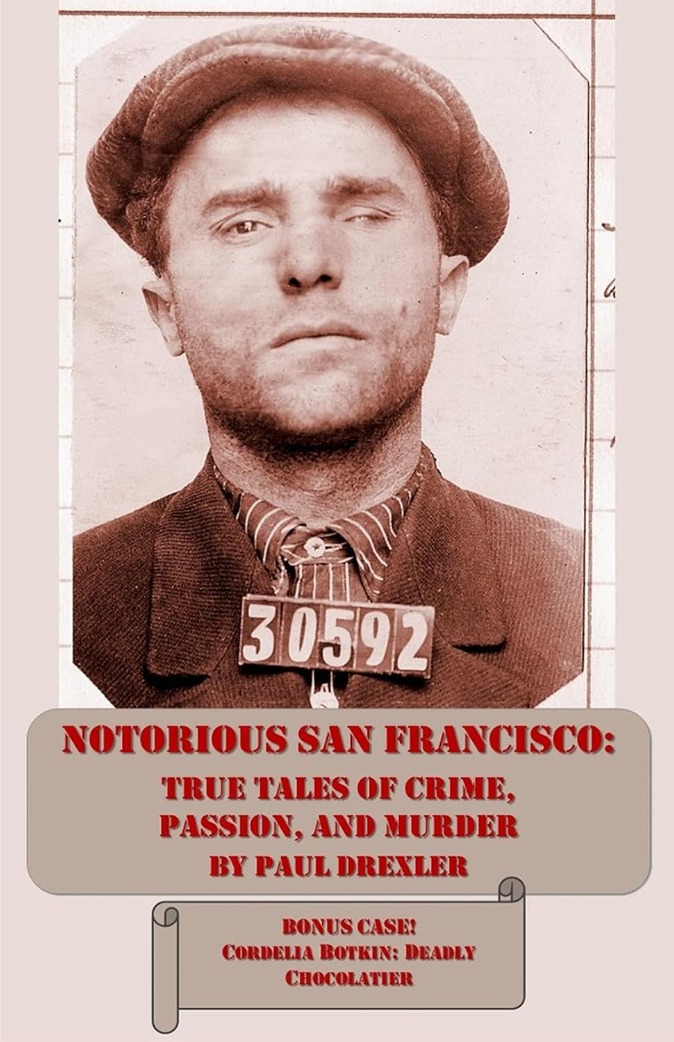
Paul Drexler is a San Francisco crime historian and writer. He is is the author of Notorious San Francisco, Murder to Movies, and over 50 true crime stories for the S.F. Examiner His column, “Notorious Crooks,” appears regularly in the Sunday San Francisco Examiner. Paul directs Crooks Tours of San Francisco, which offers walking crime tours of Chinatown and the Barbary Coast.
Drexler has taught crime history at San Francisco State, and appeared on the Discovery ID Network show Deadly Women as an expert on San Francisco murderesses, and on Paramount TV as an expert on the Zodiac Killer. In July 2017 he received the Oscar Lewis Award from the San Francisco History Association for his writing.
Read other Paul Drexler books on Amazon:
Header Photo: "Riot Radio" by Arielle Calderon / Flickr / CC By / Cropped
Silver Screen Video Banner Photos: pedrojperez / Morguefile; wintersixfour / Morguefile
Join Button: "Film Element" by Stockphotosforfree
Twitter Icon: "Twitter Icon" by Freepik
Facebook Icon: "Facebook Icon" by Freepik
LinkedIn Icon: "LinkedIn Icon" by Fathema Khanom / Freepik
Goodreads Icon: "Letter G Icon" by arnikahossain / Freepik
Certain images on this site appear courtesy of Amazon.com and other sponsors of Silver Screen Videos for the purpose of advertising products on those sites. Silver Screen Videos earns commissions from purchases on those sites.
© 2026 Steven R. Silver. All rights reserved.
